
There are loud bands, and then there are bands like Family of Addiction. The kind that don’t just play a…
By K Futur LOCALHiking out onto Bleaklow Moor is never just a walk. It is an approach, a gradual leaving behind of roads, cars and certainty. From Snake Pass, not far from the familiar ribbon of tarmac that cuts between Sheffield and Glossop, the land opens into something broader and more exposed. The path towards Higher Shelf Stones is a relatively easy hike by Peak District standards, but it demands attention. The ground can be heavy with peat, boggy underfoot after rain, and deceptively tiring as the landscape stretches on. It is far enough from the road to feel genuinely remote, and close enough to civilisation to make that remoteness unsettling. It is absolutely a place everyone should visit if they can, but it is not somewhere you rush to.
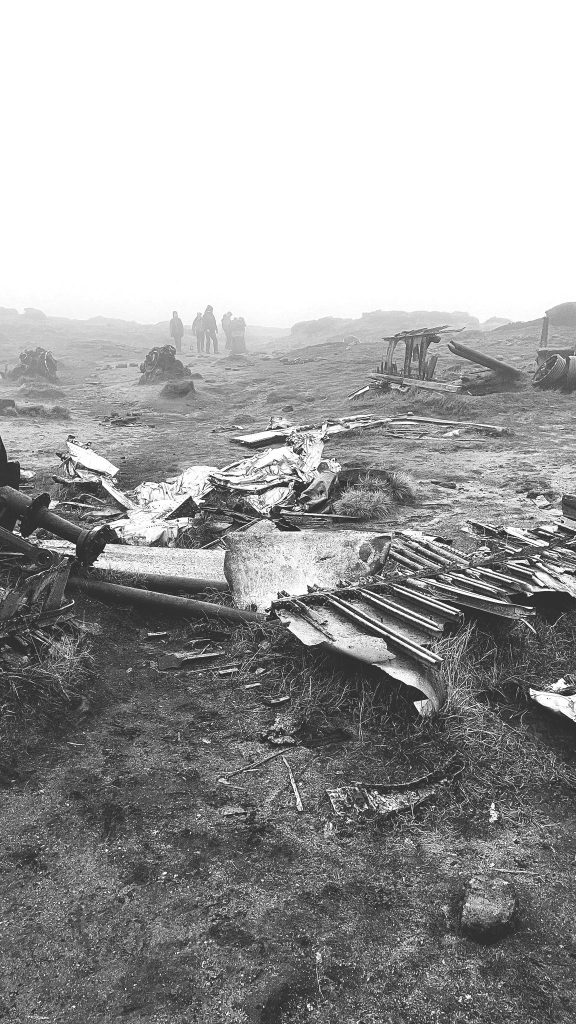
If you have never been before, the first encounter with the Bleaklow Bomber crash site is quiet, eerie and profoundly sad. The silence often feels deliberate, as if the moor itself insists on it. On my first visit, the weather was cold, damp and misty. Low cloud sat stubbornly across the plateau, swallowing sound and softening distance. There were a few other people scattered across the moor, but no one spoke. Figures appeared briefly as silhouettes in the mist, then dissolved again into the grey. It was impossible not to feel that this was a place where voices did not belong.
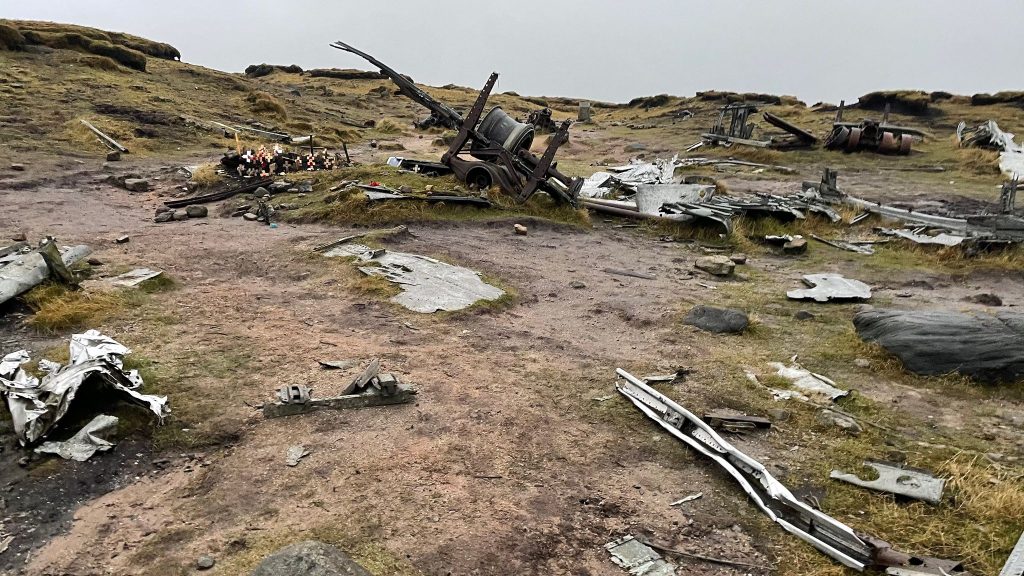
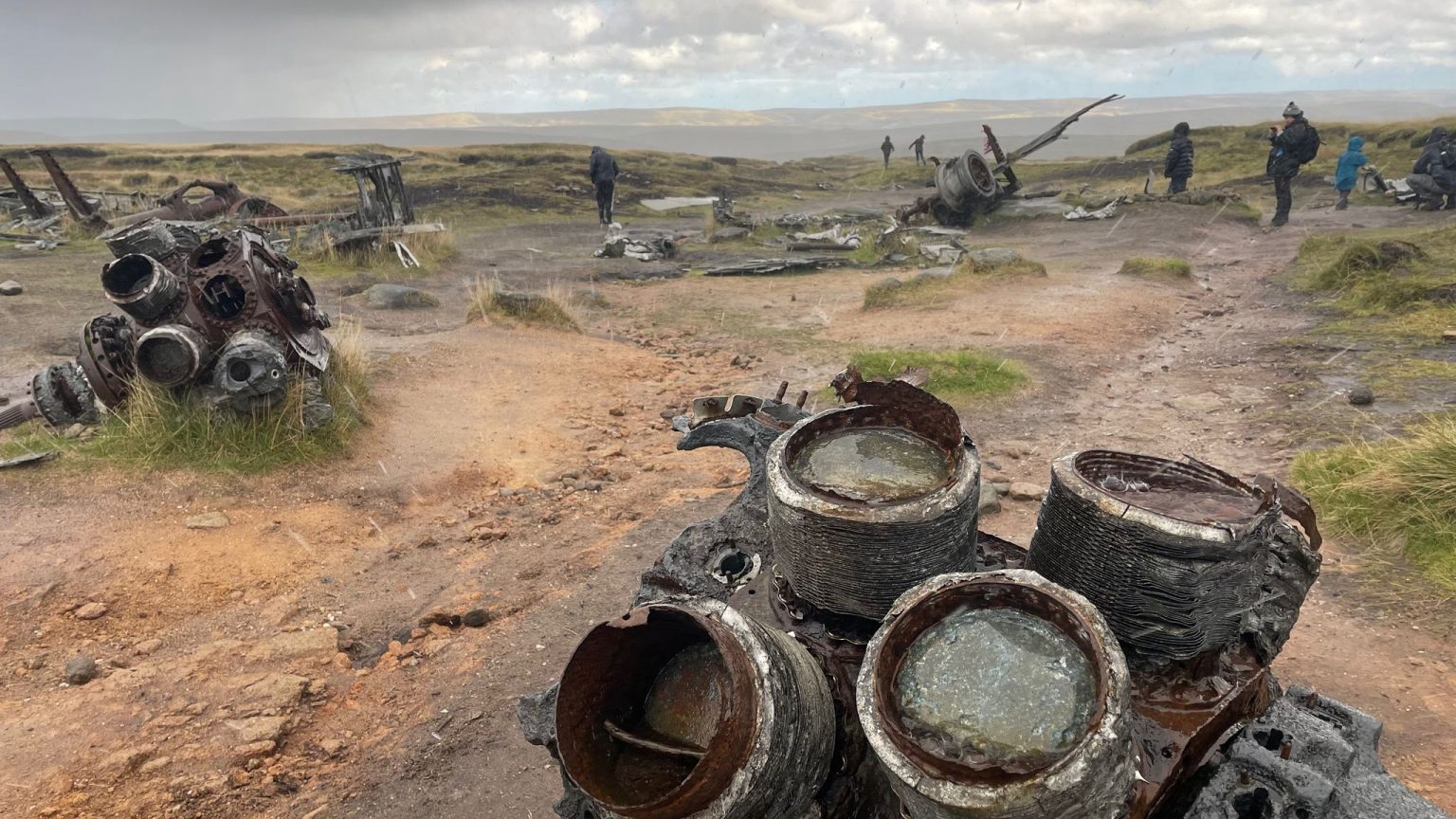
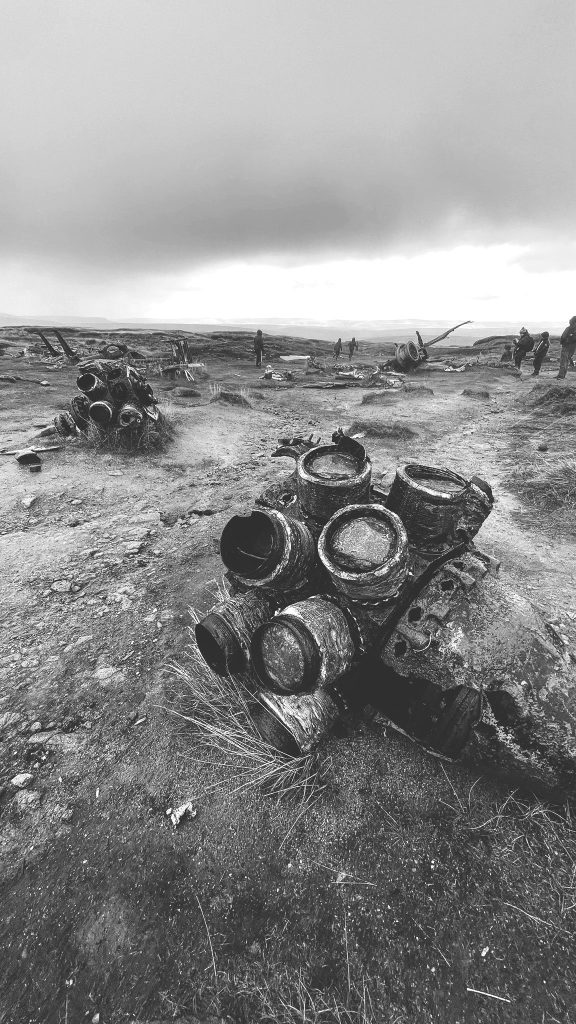
And then the wreckage reveals itself. Not all at once, but in fragments. Twisted aluminium half-buried in peat. The unmistakable curve of wing sections. The hulking presence of Duplex-Cyclone engines lying where they fell. Nuts, bolts, undercarriage parts, fuselage sections, remnants of gun turrets. The stunning, rolling landscape of the Peak District is strewn with the remains of an aircraft that should never have been there, and yet, after more than seventy years, it somehow feels inseparable from the land. Industrial, man-made debris sits against heather, moss and stone, and instead of clashing, the two have fused. Nature has not erased the wreckage. It has adopted it.
This strange harmony makes the site all the more haunting when you understand what happened here.
The wreckage on Bleaklow Moor is what remains of a Boeing RB-29A Superfortress, serial number 44-61999, known as Overexposed. On 3 November 1948, the aircraft was flying a routine daytime flight as part of the United States Air Force’s 16th Photographic Reconnaissance Squadron, under the 91st Reconnaissance Group and 311th Air Division of Strategic Air Command. It left RAF Scampton near Lincoln at around 10:15 in the morning, bound for the US Air Force base at Burtonwood near Warrington, flying alongside two other aircraft.
Overexposed was no ordinary bomber. It had an extraordinary service history. In July 1946 it had flown with the 509th Composite Group during Operation Crossroads, photographing nuclear testing at Bikini Atoll, including the atomic bomb dropped by the B-29 Superfortress Dave’s Dream. It later took part in the Berlin Airlift in 1948, playing a role in one of the most significant humanitarian operations of the post-war era. By the time it crossed the Peak District that November morning, it was a veteran aircraft, repurposed for photographic reconnaissance, mapping and observation.
The weather over Bleaklow that day was unforgiving. Thick fog and low cloud covered the high plateau, reducing visibility to almost nothing. Captain Landon Tanner and co-pilot Captain Harry Stroud were flying entirely by instruments. Based on flight-time calculations, the crew believed they had already cleared the high ground of the Pennines and began their descent. They had not. At approximately 11:00, the aircraft struck the moor at around 610 metres above sea level, just 300 metres north-east of the summit of Higher Shelf Stones. The impact was catastrophic. The aircraft was engulfed in flames, and all thirteen men on board were killed instantly.
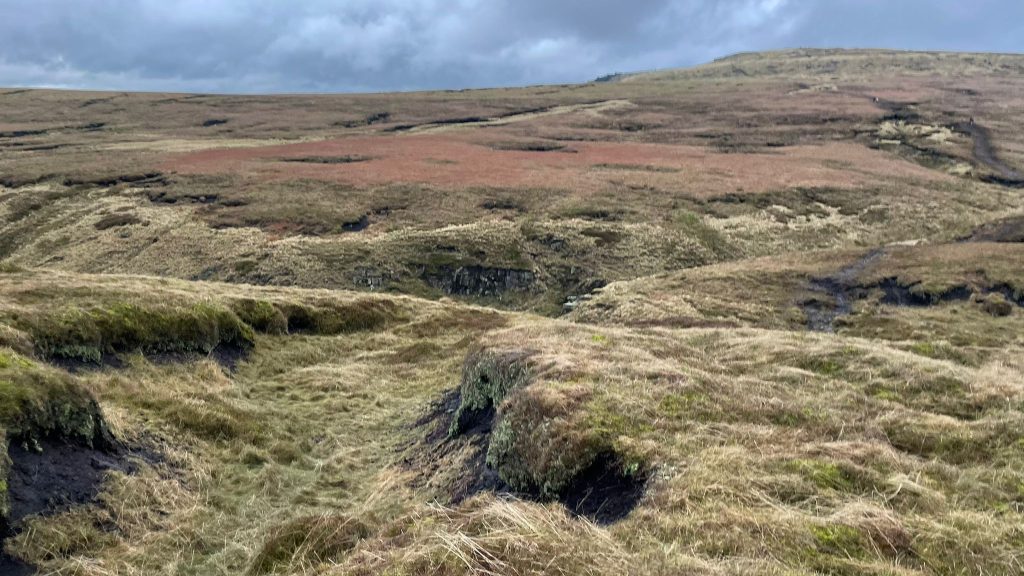
Standing on the moor today, particularly when mist drifts low across the land, it is painfully easy to understand how such a navigation error could occur. The landscape offers few clear reference points. Hills rise gently rather than dramatically. In low cloud, horizon and ground blur into one. The same silence that visitors experience now would have existed then, broken only by engine noise and wind. Bleaklow does not announce itself as danger. It conceals it.
When Overexposed failed to arrive at Burtonwood, the RAF Mountain Rescue Service was called into action. Coincidentally, an RAF Harpur Hill rescue team was already on a training exercise on the Kinder Scout moors. They headed towards Bleaklow and located the crash site at around 16:30, with daylight already fading. The debris field was vast, with wreckage scattered across the moor and only the tail section remaining relatively intact. The recovery of the bodies took place the following morning, and the crew were transported to Burtonwood. Remarkably, the aircraft had been carrying $7,400 in wages for the Burtonwood airbase. The money survived the fire and was recovered from the crash site by American Military Police.
Thirteen men died on Bleaklow Moor that day. Captain Landon P. Tanner, the pilot. Captain Harry A. Stroud, the co-pilot. Sergeant Ralph W. Fields, engineer. Sergeant Charles R. Wilbanks, navigator. Sergeant Gene A. Gartner, radio operator. Sergeant David D. Moore, radar operator. Sergeant Saul R. Banks, camera crew. Sergeant Donald R. Abrogast, camera crew. Sergeant Robert I. Doyle, camera crew. Private William M. Burrows, camera crew. Corporal Clarence M. Franssen, passenger. Corporal George Ingram Jr, passenger. Captain Howard E. Keel, photographic advisor. Each name represents a life ended abruptly in a place that still bears the scars of that moment.
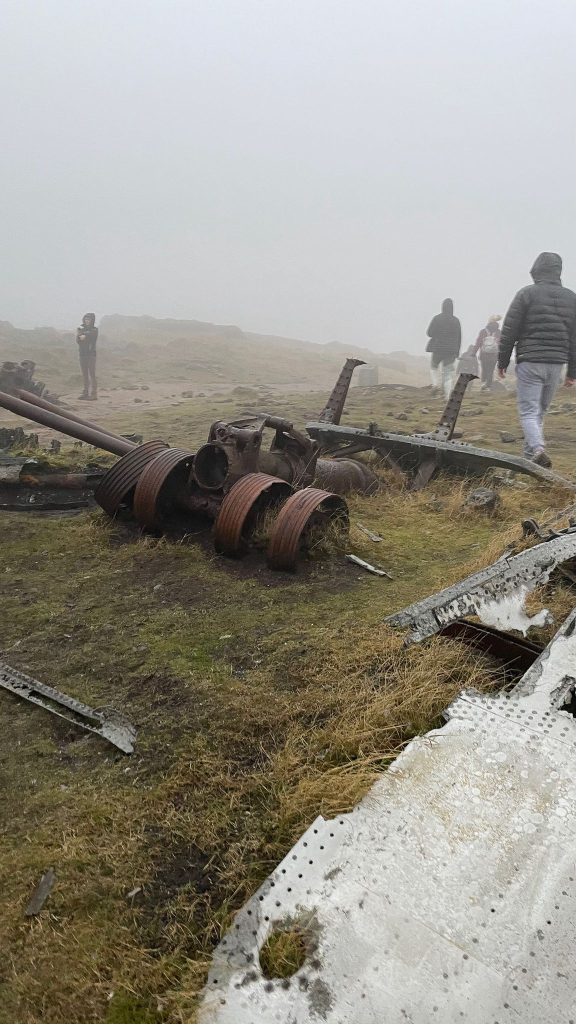
Much of the wreckage remains where it fell in 1948. Engines lie heavy and immovable in the peat. Wing sections are bent and fractured. Fuselage panels sit half-consumed by moss and heather. One of the aircraft’s gun turrets was later recovered and is now displayed at the Newark Air Museum in Nottinghamshire, offering a tangible link between the moor and the wider story of aviation history. In the 1970s, a local man discovered a ring among the wreckage. It was identified as Captain Tanner’s wedding ring and was returned to his daughter, a deeply human moment of connection across decades and distance.
In 1988, an official memorial plaque was erected at the site, formally recognising Bleaklow Moor as the final resting place of the crew. Today, the crash site functions as an open-air memorial, unguarded and uncommercialised. There are no fences, no ticket booths, no curated experience. What remains is left exposed to the elements, just as it has been for generations. Visitors are asked to treat the area with respect, to stick to paths where possible, to avoid disturbing the wreckage and to remember that this is both a sensitive environmental site and a place of loss.
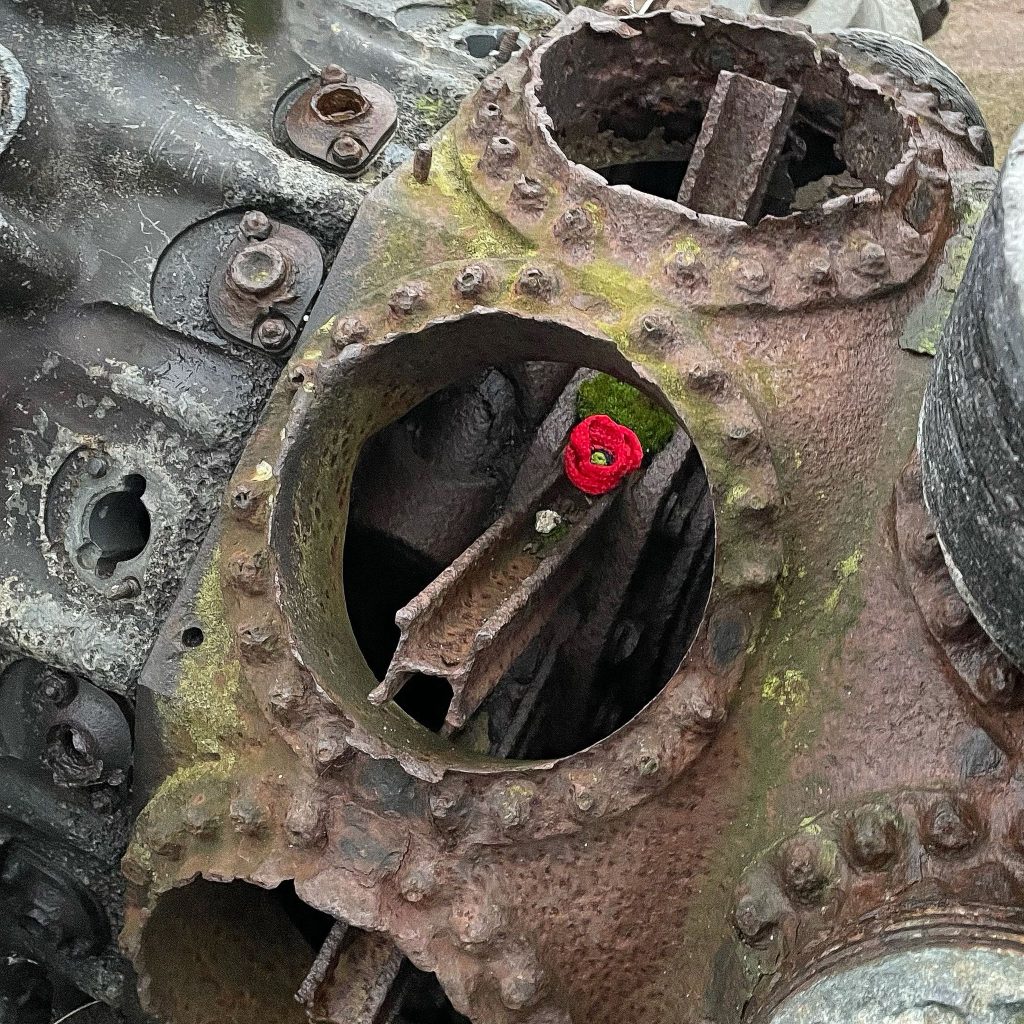
The Bleaklow Bomber site is not dramatic in the way battlefields or monuments can be. Its power lies in its stillness. The wreckage has been weathered, oxidised and softened by time. The moor has grown around it, through it and over it, without ever fully erasing it. The natural landscape serves as a backdrop to industrial fragments that feel out of place and yet perfectly at home. The carnage that occurred here, the violence of impact, the suddenness of death, and the slow, patient reclamation by nature all exist together.
It is a strangely beautiful place. Not because of what happened, but because of how it has been remembered. Bleaklow Moor does not shout its history. It whispers it, through mist, silence and scattered metal. For those willing to make the walk, to feel the bog underfoot and the cloud closing in, it offers not spectacle, but reflection. A reminder of how fragile navigation can be, how unforgiving landscapes are, and how memory can endure when treated with care.
The resting place of thirteen men lies quietly on the high plateau, watched over by peat, stone and sky. The wreckage of Overexposed remains, not as debris, but as testimony.
community-storiesgreen-spaceshidden-destinationslocal-culturetravel-and-leisure